Top Comments
> "Consistent with prior Opus models, Opus 5 does not have data retention requirements for general access."[1]
On the Opus model release page, the reason why Fable doesn't have an ARC-AGI score is because of that retention policy[2].
0: https://support.claude.com/en/articles/15425996-data-retenti...
Previously Fable was the best at this, followed by Gemini 3.1 pro (a surprising #2, but Google has great vision models).
Opus' results seem to be more accurate than Fable, following the design source of truth better.
Example results:
Design source of truth: https://image.non.io/73e239a3-880f-4793-b65f-4810be2d9378.we...
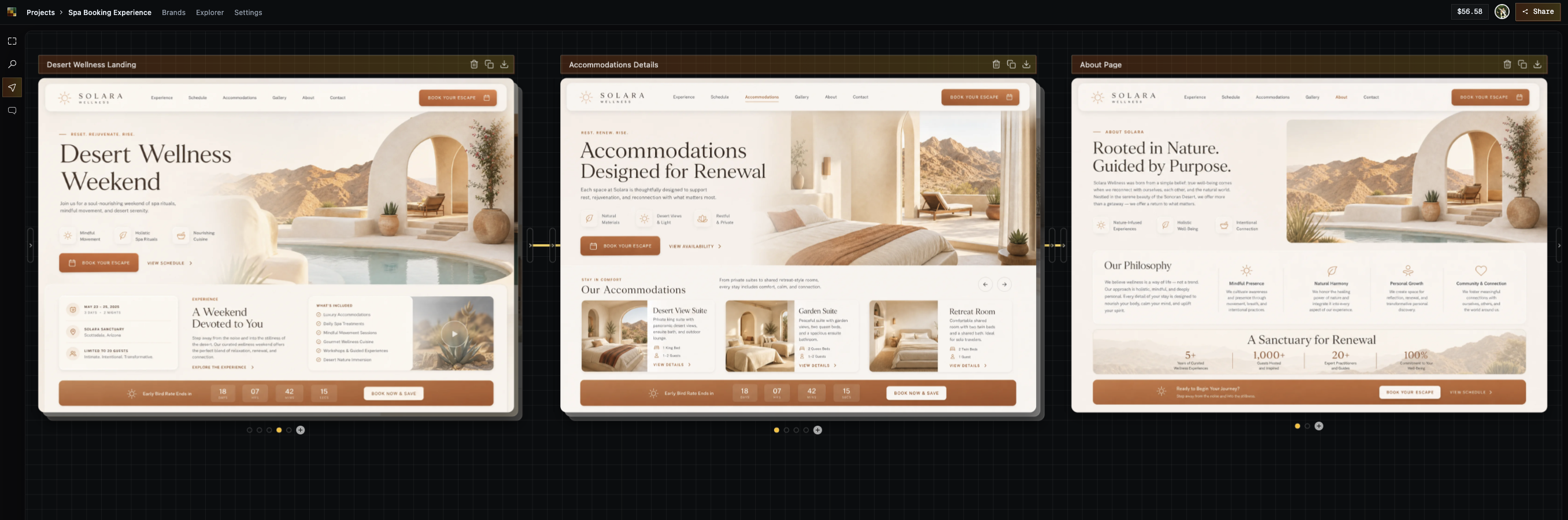
Opus 5 build: https://html.non.io/solaraOpus/
Fable 5 build: https://html.non.io/solara/
Note the buttons - for fable they're pill buttons, opus got the rounded rectangle nature of them. Opus' images are closer to the source of truth as well (both LLMs were provided with image gen capabilities for the assets).
Running more tests now, but preliminary results are saying this is indeed better than Fable in some areas. Crazy.
Opus 5 still uses "carry the argument", "worth stating plainly", ", and the trap", "The X matters more", the use of "move"
We need an "annoying English" benchmark.
- Fable 5 Max: https://gist.github.com/deet/3d97f854b48eac6658d642fa18bb24d...
- Opus 5 Max: https://gist.github.com/deet/1a43693a732dfccb4d0d914bfc42692...
There are 10+ LLM companies, each with dozens of models of different modalities, each model with multiple size variants, then different “thinking” levels, then agentic modes, “pro” modes, a “fast” option, standard vs flex vs batch execution. And of course each end combination has a different input/output/cache token price.
Companies that say “give me a prompt and I’ll route it to the most ideal and cost effective model and setting for you” are capturing a ton of value from a gap that model developers don’t seem to understand exists.
---------------
Why does Anthropic say here that Opus 4.8 scored 55.7% on OSWorld 2.0 benchmark, but the paper published by the authors of OSWorld 2.0 say they achieved a benchmark of ~21% with Opus 4.8? [0]
That's a huge gap, considering that the paper was published just 2-4 weeks ago.
I understand that the benchmark authors have an incentive to publish lower numbers (to show that the benchmark has potential longevity) and that Anthropic has incentive to publish higher numbers, but the other models seem pretty inflated as well. The benchmark authors shows GPT-5.5 at 14%, and Anthropic shows GPT-5.6 Sol at 62.6%.
Is there any reasonable explanation for this? Do all the other benchmark numbers need to be sanity-checked as well? Are SOTA benchmarks really this difficult to get consistent, replicable results within a reasonable range of tolerance/variability? Can these benchmarks be compared from one paper to another, or are they only valid to compare intra-paper results?
Visit the Original Link
Read the full content on anthropic.com