This is a submission for the Hacktoberfest Open-Source AI Challenge Week 3: Slow and Steady
I had 1,247 articles saved "for later." This week I let a model on my laptop throw almost all of them away, and I have never felt lighter.
Let me tell you why that was so hard, and why I would do it again.
"Read later" is the most optimistic lie in software. Every tab I save is a tiny promise to a future version of me who does not exist, the one with a free Sunday and a cup of tea and nothing better to do. That version is never coming. So the pile just sits there, 1,247 promises deep, and taxes me a little guilt every single time I open a new tab. I was not keeping those articles. They were keeping me.
The challenge this week, "Slow and Steady," asks for something that rewards laziness: channel your inner sloth, build the thing that does the work so you do not have to. So I built the one thing I was too afraid to do by hand. An agent that reads the whole pile overnight, on my own laptop, with the Wi-Fi off, learns which handful I will genuinely read, and then does the scary part for me: it deletes the rest. No cloud. No account. No cost. No more guilt.
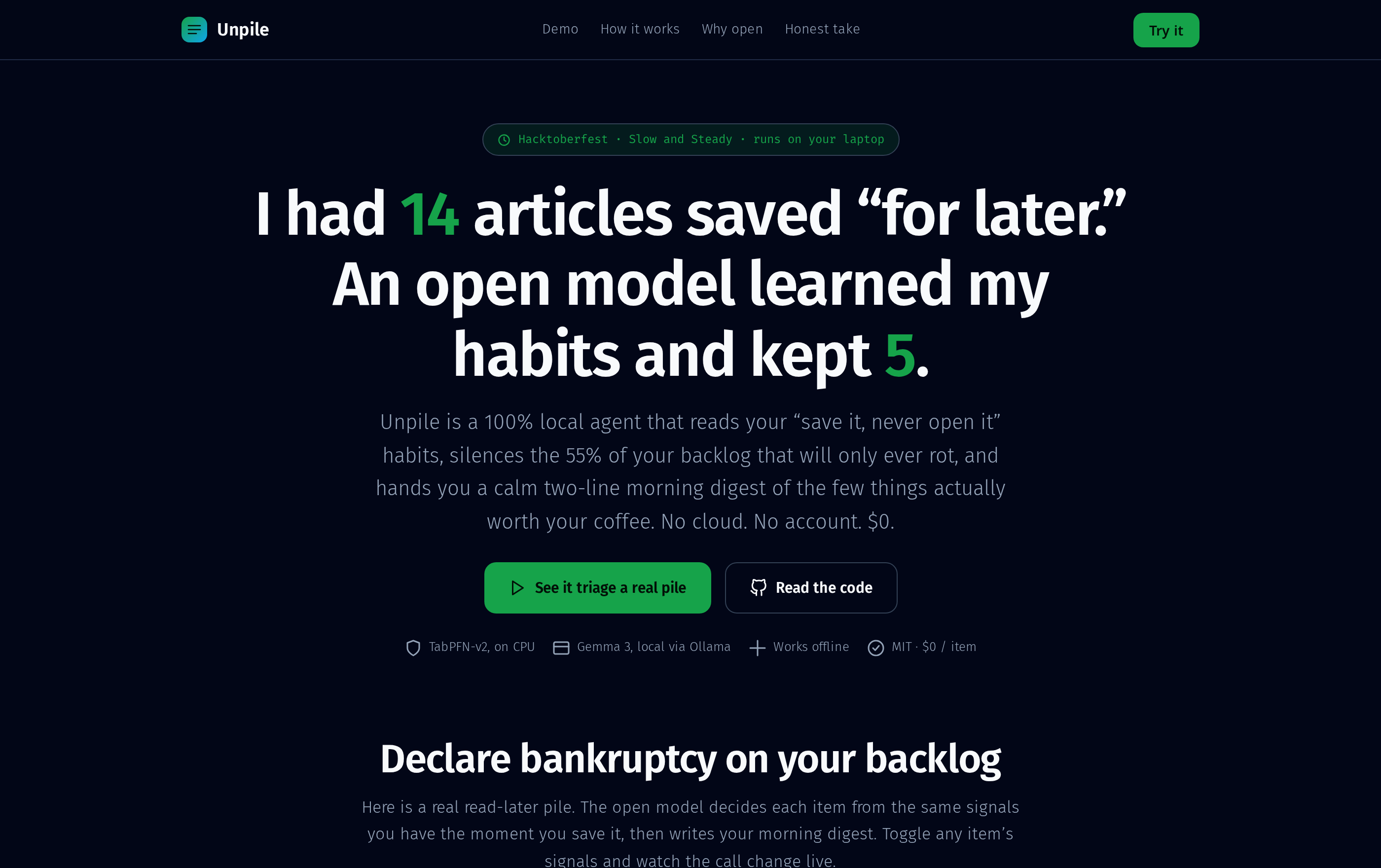
It is called Unpile. On the demo pile it reads 14 saved items, keeps the 5 worth my morning, flags 1 maybe, and silences 8, handing back 5.5 hours of reading time I was lying to myself about. Point it at a real 1,200-item backlog and it quietly clears years of guilt while you sleep.
What I Built
Unpile is a local triage agent for your read-later backlog.
You point it at an export (Pocket, Instapaper, browser bookmarks, a CSV) and it does four things, all on your machine:
- Learns your taste from your own history of what you actually read versus what rotted in the pile.
- Decides every item: keep, skim, or drop, each with a calibrated probability that you will read it.
- Writes a calm two-line morning digest of only the keepers.
- Silences everything else, so you wake up to five good things instead of a wall of guilt.
The effort it saves is the whole point of the challenge. You stop being the triage system. You stop scrolling a backlog deciding, item by item, "do I care about this?" The model does that boring, repetitive judgment call thousands of times and only taps you on the shoulder for the handful that survive. That is the sloth philosophy in one line: it does the work so you do not have to, and you get your attention back.
Who gets to be lazier? Anyone with a doom-pile of unread tabs. Which, let us be honest, is every single person reading this.
Demo
Live, in your browser (no setup, real baked model output): https://simplynadaf.github.io/unpile-read-later-triage
Video walkthrough: watch on YouTube
The 60-second walkthrough goes end to end: the open-source repo, then the real pipeline running in a terminal (the reading history TabPFN learns from, the keep/skim/drop call with a reason for every item, the local Gemma digest, and the honest held-out scorecard), then the live site. Nothing is staged; the numbers on screen are the actual program output.

And here is the triaged pile itself: five keepers on the left (each with the reasons it survived and a one-line Gemma digest), one borderline maybe in the middle, and the eight it silenced on the right, the 11pm two-hour video essay, the "someday build a cabin" photo essay, the tabs-versus-spaces flamewar.

The whole thing runs on a plain CPU. The numbers on the page are the real TabPFN-v2 and Gemma output, frozen into the static site so the demo cannot break in front of you; toggle any item and an in-browser mirror of the model re-decides live.
Code
 simplynadaf
/
unpile-read-later-triage
A 100% local agent that triages your read-later backlog with TabPFN-v2 and Gemma 3, keeping only the few articles worth your morning. Open-weight, offline, $0. Hacktoberfest 2026 Week 3.
🦥 U N P I L E
⚡ Declare Bankruptcy on Your Read-Later Pile ⚡
An open model, on your own laptop, reads your doom-pile of saved articles overnight,
keeps the handful you will actually read, and silences the rest. Offline. Free. Private.


| 📥 Point it at your pile |
➡️ | 🧠 TabPFN decides keep / skim / drop |
➡️ | ☕ Gemma writes your morning note |
➡️ | 🧘 You wake up to 5, not 1,247 |
🚀 Live Preview · ▶ Watch the Demo · 🧠 How It Works · ⚖️ Why Open
🎬 Demo

A 60-second walk, end to end: the open-source repo → the real pipeline running in a terminal (the history TabPFN learns from, the keep/skim/drop call with a reason for every item, the local Gemma digest, the honest scorecard) → the live site. Nothing staged; every number is real program output.
How I Built It
Two open-weight models, one job each. Neither is decoration; take either one out and the project stops working.
TabPFN-v2 is the decision brain
TabPFN (Prior Labs) is an open-weight tabular foundation model. You do not train it. You hand it your history as context and it predicts in a single forward pass. For Unpile, the history is a table of saved items with the signals you know the moment you save something (source, topic, estimated read time, how stale it is, how many times you reopened the tab, whether it is an actionable how-to, how buried it is) and one honest label: did you ever actually read it?
Prior Labs specifically favors TabPFN used inside a wider prediction agent, not as a bare .predict() call. So Unpile wraps it in a real agent loop:
# predict P(you read it) for the whole pile in ONE CPU forward pass
probs = self._proba(items)

for item, p in zip(items, probs):
    action = self._decide(p)        # keep / skim / drop from a tunable keep budget
    reasons = self._reasons(item)   # plain-language "why", so the call is auditable
    ...                             # keep the few, flag the maybes, silence the rot
It predicts, decides an action, explains that action in plain language, and then reports honest held-out metrics on itself. That last part matters, and I will come back to it.
I used TabPFN-v2 on purpose: it decides the whole pile in a single CPU forward pass, no GPU and no training run, which is exactly what lets Unpile run overnight on the laptop you already own.
Gemma 3 is the writer
Gemma 3 runs locally through Ollama and writes the morning digest. It is given the keepers and their probabilities and told to never invent an item. If Ollama is busy or the machine is offline, a deterministic fallback writes a correct digest anyway, so the summary always arrives:
def write_digest(keepers):
    try:
        return gemma_via_ollama(keepers)      # calm two-line morning note, local
    except Exception:
        return rule_based(keepers)            # never blocks your morning
The stack is FastAPI, a synthetic-but-documented dataset, a single-file no-build UI, and GitHub Pages for the live demo. All CPU, all local.
Why Does Open Innovation Matter?
Your reading list is a confession. It leaks your job, your health, your politics, the thing you are quietly trying to learn. That is exactly the data I refuse to send to someone else's server, and it is the reason this had to be open.
- Your history never leaves the laptop. A closed API would need every row uploaded. TabPFN and Gemma run on-device, so it stays with you.
- It works with the Wi-Fi off. Open weights mean the overnight triage does not depend on a connection, a login, or a vendor being awake.
- It is free, at any scale. Triaging a 1,200-item backlog on a per-call API is a real bill. On open weights it is zero, so I can run it nightly and never think about cost.
- It learns me, not the average. Retrain the decision on my own labels and it mirrors my taste. A closed, general model cannot be bent to one person's weird pile the way an open one can.
A closed API could summarize an article. It could not become a private, offline, free thing that learns my specific reading habits and keeps running on hardware I already own, long after any free tier would have expired. That is the part only open makes possible, and it is the entire reason Unpile exists.
The Lazy Payoff
Here is what this actually bought me, and it was not time. It was permission to let go.
I used to be the triage system. Every few days I would open that folder, feel the weight of 1,247 unread promises, scroll a bit, close it, and feel slightly worse than before. The backlog was not a to-do list. It was a slow-drip guilt machine I had built for myself, one hopeful tab at a time. What I could never do was the obvious thing: just delete them. Deleting felt like admitting I would never become the person who reads 1,247 articles. So I never did. The pile only grew.
The model does not have that hang-up. It looked at my own history, decided which five were real, and threw the rest away without a flicker of guilt, because it does not have any. I did not read 1,242 items this week. I did not even look at them. And the folder that used to make me wince now makes me feel nothing at all, which, after years of that quiet tax, feels like a lot.
Quantified in the only currency the challenge cares about: 8 of 14 items silenced with zero input from me, and 5.5 hours of reading time handed back, time I was lying to myself about anyway. Point it at a real 1,200-item backlog and it is clearing years of that guilt while I sleep. The sloth philosophy, literally: move slow, conserve energy, let the boring, frightening part happen without you.
The Honest Take
Here is the scorecard, measured on a held-out slice of 240 saved items the model never saw, because a number I cannot check is just a vibe.
- Precision 0.60: when Unpile surfaces something, I actually read it about 60% of the time, against a 36% base rate in the raw pile. It nearly doubles the odds that the thing in front of me is worth it.
- Lift 1.66x: the kept pile reads 1.66 times better than a random grab from the backlog.
- Silenced 58%: it auto-archives well over half the pile with no input from me. That is the laziness, quantified.
- Reclaimed 5.5 hours on the 14-item demo alone. Scale that to a real 1,200-item backlog and the model is doing days of triage you were never going to do yourself.
And now the number I am putting right next to the good ones, on purpose:
- Wrongly dropped 44%. At this setting, of the items I genuinely would have read, it also silenced about 44% of them. The most painful miss on the demo pile is "this week in AI (issue #214)" at 37% confidence: a fresh newsletter in a topic I follow, and it landed just under the keep line. It got silenced. On another morning I would have wanted it.
I am not hiding that. Unpile is not magic; it trades recall for a calm morning. But the fix is a dial, not a lie: loosen one threshold (UNPILE_KEEP_T) and you recover more of those near-misses at the price of a slightly noisier digest. I would rather ship the honest trade-off, with the failure case named out loud, than a demo that pretends false negatives do not exist.
Prize Categories
- Best Use of TabPFN (featured): TabPFN-v2 is the decision brain, used as a real prediction agent (predict, decide, explain, measure) over a personal CSV, with honest held-out metrics, exactly the "prediction agent" pattern Prior Labs favors over a bare classifier.
- Best Use of Gemma (featured): Gemma 3 runs locally via Ollama to write the morning digest, grounded strictly on the model's own output, with a deterministic offline fallback so it never hard-fails.
Built new for this challenge (Oct 19 to 25). It reuses my own local-AI patterns from earlier weeks, re-applied to a new problem, dataset, agent loop, and UI, disclosed in the README per the credit rule.
Thanks for reading all the way down. You just did something your backlog never let you do: you finished. Now go let a model read the rest for you.