
Your Pipeline Is 26.6h Behind: Catching World Sentiment Leads with Pulsebit
Just yesterday, we noticed a significant anomaly: a 24-hour momentum spike of +0.185. This spike coincides with the leading English press coverage, which was ahead by 26.6 hours. The dominant narrative, encapsulated in the cluster story titled "World Cup | Michel Struthoff’s strike extends Germany’s reign," indicates a powerful trend that any effective sentiment analysis should seize upon. This isn’t just another data point; it’s a clear signal that something is stirring in global sentiment.
The Problem
If your pipeline doesn't account for multilingual origins or entity dominance, you're missing out on insights like this by over 26 hours. This is not an insignificant gap. Your model is likely lagging behind critical trends that are shaping public sentiment, particularly when you consider that this spike emerged from English-language articles. By neglecting the nuances of language and regional focus, you're potentially sidelining vital narratives that can inform strategic decisions.

English coverage led by 26.6 hours. Sq at T+26.6h. Confidence scores: English 0.85, Spanish 0.85, French 0.85 Source: Pulsebit /sentiment_by_lang.
The Code
To catch this momentum spike, we need to grab data using our API with the right filters. Here’s how you can implement it in Python:
import requests
# Define parameters for the API call
topic = 'world'
score = +0.103
confidence = 0.85
momentum = +0.185
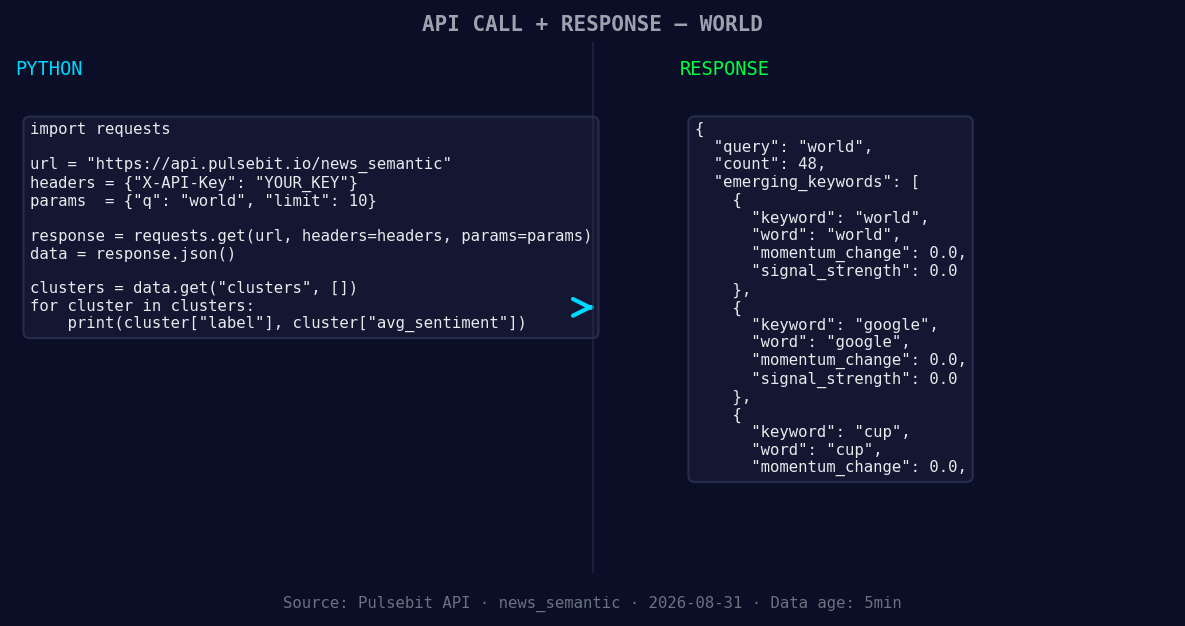
*Left: Python GET /news_semantic call for 'world'. Right: returned JSON response structure (clusters: 3). Source: Pulsebit /news_semantic.*
# Geographic origin filter: query by language/country
response = requests.get(
'https://api.pulsebit.com/sentiment',
params={
'topic': topic,
'lang': 'en',
'momentum_threshold': momentum,
}
)
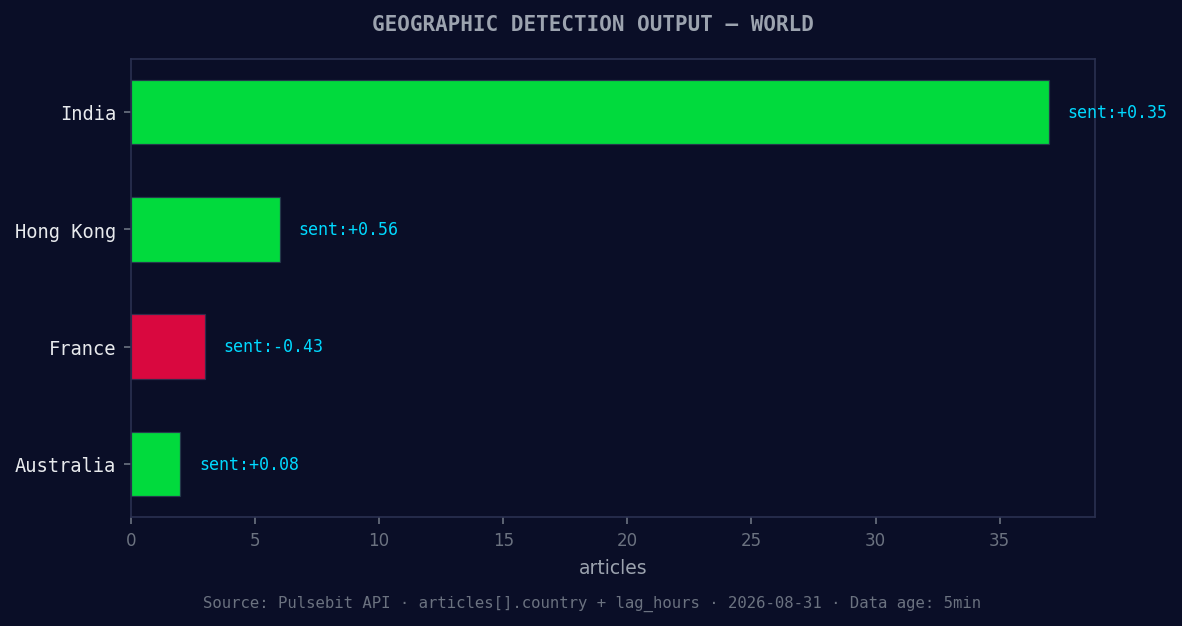
*Geographic detection output for world. India leads with 37 articles and sentiment +0.35. Source: Pulsebit /news_recent geographic fields.*
# Check if the API call was successful
if response.status_code == 200:
data = response.json()
print(data)
else:
print("Error:", response.status_code)
# Now, let's run the cluster reason string back through POST /sentiment
cluster_reason = "Clustered by shared themes: world, cup, michel, reign, struthoff’s."
sentiment_response = requests.post(
'https://api.pulsebit.com/sentiment',
json={
'text': cluster_reason,
'confidence': confidence,
}
)
# Output the sentiment analysis of the narrative framing
if sentiment_response.status_code == 200:
sentiment_data = sentiment_response.json()
print(sentiment_data)
else:
print("Error:", sentiment_response.status_code)
This code first captures sentiment data related to the topic "world", filtered for English language content. It then scores the narrative framing of the news article, allowing us to assess the sentiment surrounding the cluster themes, which include "world," "cup," "michel," and "struthoff’s." This dual approach of filtering and sentiment analysis is crucial for understanding the broader sentiment landscape.
Three Builds Tonight
Here are three specific builds we can implement using this pattern:
Geo-filtered Sentiment Analysis: Create an alert system that triggers when the momentum score exceeds a specific threshold (e.g., +0.185). Use the geo filter to monitor sentiment around "world" in English-language articles. This would allow you to catch spikes in sentiment specific to regions.
Meta-Sentiment Scoring: Develop a dashboard that visualizes the sentiment score of the cluster reason strings. Use the POST /sentiment endpoint to continually analyze phrases like "Clustered by shared themes: world, cup, michel, reign, struthoff’s." This will help you understand how narratives evolve over time.
Mainstream vs. Forming Themes: Set up a comparative analysis between mainstream sentiments (e.g., “world,” “cup,” “michel”) and forming themes (e.g., “world(+0.00), google(+0.00), cup(+0.00)”). Use this to identify emerging topics that might not yet be mainstream but show potential growth.
Get Started
To explore further, visit pulsebit.lojenterprise.com/docs. You can copy-paste the above code and run it in under 10 minutes. With this approach, you can make sure your analysis is not just timely, but also insightful, capturing the pulse of global sentiment effectively.


