
Your pipeline might be 26.8 hours behind if it isn't handling multilingual sources effectively. We recently discovered a significant anomaly: a 24h momentum spike of +0.700 in sentiment surrounding business topics. This isn't just a number; it represents a vibrant narrative shift that's being led by the Spanish press. If your model isn’t tuned to catch these shifts, you're missing valuable insights that could inform your strategies.

Spanish coverage led by 26.8 hours. Sq at T+26.8h. Confidence scores: Spanish 0.75, English 0.75, French 0.75 Source: Pulsebit /sentiment_by_lang.
This discovery highlights a structural gap in many pipelines that don’t factor in multilingual origins or entity dominance. Your model missed this by 26.8 hours, while the leading language is Spanish, with no lag time. In environments where sentiment can change rapidly, failing to account for such variance can result in lost opportunities for actionable intelligence.
Let’s dive into how to catch these insights programmatically. First, we will filter for content in Spanish using our API, and then we’ll analyze the narrative framing through sentiment analysis. Below is the code that accomplishes this:
import requests
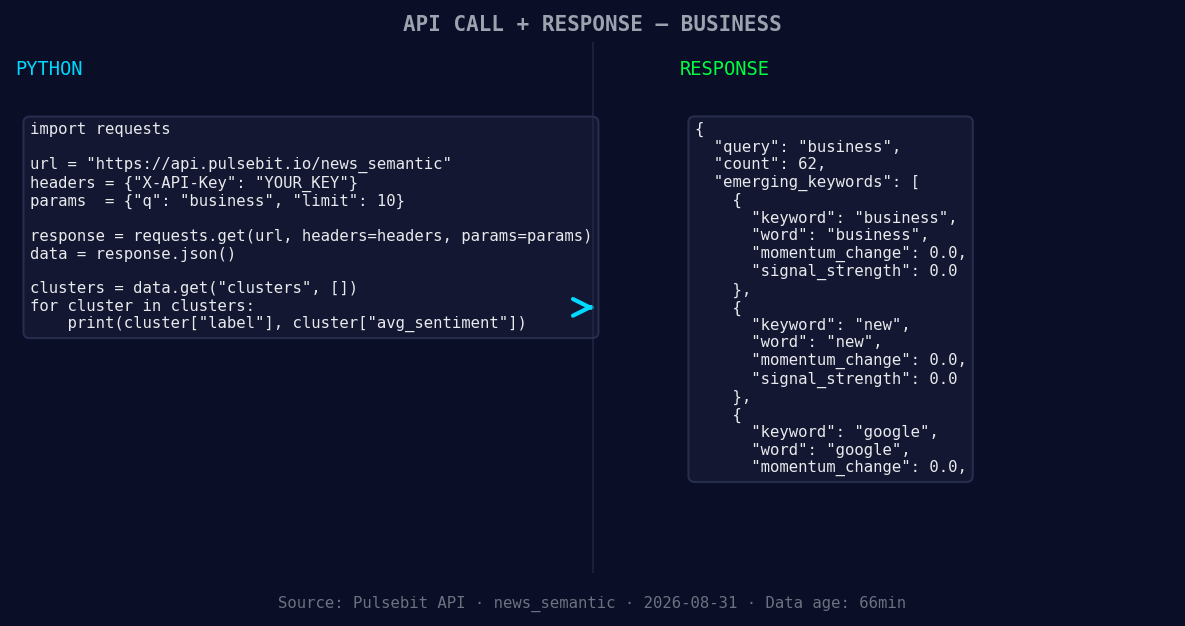
*Left: Python GET /news_semantic call for 'business'. Right: returned JSON response structure (clusters: 3). Source: Pulsebit /news_semantic.*
# Step 1: Query by language
response = requests.get('https://api.pulsebit.com/data',
params={
'topic': 'business',
'lang': 'sp',
'momentum': 0.700,
'articles_processed': 62,
})
data = response.json()
# Step 2: Analyze narrative framing
cluster_reason = "Clustered by shared themes: college, football, field, into, farm."
sentiment_response = requests.post('https://api.pulsebit.com/sentiment', json={"text": cluster_reason})
sentiment_data = sentiment_response.json()
print("Filtered Data:", data)
print("Sentiment Analysis:", sentiment_data)
In this example, we’re querying for business-related topics specifically in Spanish, ensuring we catch that 24h momentum spike. Then, we analyze the cluster reason string to get a deeper understanding of the narrative framing, which is critical for surfacing the right insights.
What can you build with this newfound data pattern? Here are three specific ideas:
Geo-Targeted Alerts: Set up a webhook that triggers when sentiment around business topics in Spanish exceeds a threshold, for instance, a momentum spike of +0.500. This allows you to react quickly to regional sentiment changes.
Meta-Sentiment Dashboard: Create a dashboard that visualizes sentiment scores and their historical trends for clusters like "college, football, field." Use the output from the sentiment analysis to enrich your insights into how these themes are evolving over time.
Forming Themes Tracker: Build a script that continuously monitors forming themes in business, new, and Google. Alert yourself when the sentiment score for these themes rises above a given threshold, such as +0.005, so you can keep your strategy agile.
By implementing these builds, you can harness the power of sentiment data effectively, ensuring you're always in tune with the latest shifts in public opinion.
To get started, head over to pulsebit.lojenterprise.com/docs. With the provided snippets, you can copy, paste, and run this in under 10 minutes, making your pipeline more responsive to crucial sentiment changes. Don't let your insights lag behind.

Geographic detection output for business. India leads with 2 articles and sentiment +0.80. Source: Pulsebit /news_recent geographic fields.


